
Difference between Traditional WAN and SD WAN
With corporations evolving and businesses trusting the applications stored in the cloud, more confusion and improved networking solutions that are faster, dependable, and cheaper have become primordial. Wide Area Networks have been the cornerstone of enterprise networking for an extended period, but with the advent of SDN WANs provide a more adaptable technique towards the traffic across several sites. Comparing Traditional WAN with SD-WAN is essential for organizations that need to modify their network architecture to meet the demands of today’s economy.
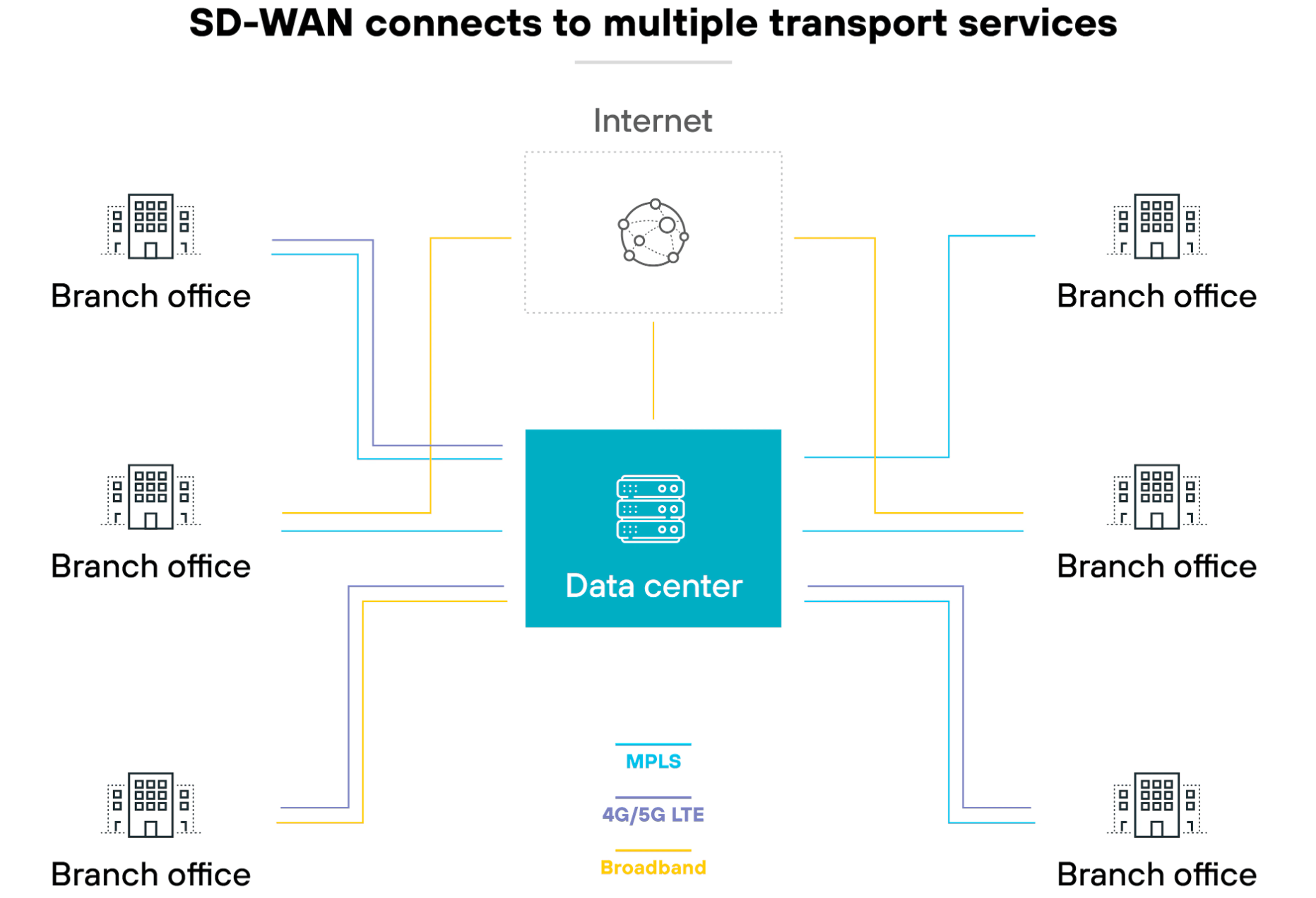
Traditional WAN
Traditional network is based on completely hardware network devices that mostly rely on Multi-Protocol Label Switching (MPLS) for resilient and efficient network traffic flow. A number of hardware devices are installed along with proprietary circuits to route IP services to their intended clients. IT teams make a lot of great effort to manage the network as it involves layers of underlying hardware installed. Scaling a traditional network is difficult as it needs proper advanced planning along with the required network infrastructure to set up and run. A Traditional connects many Local Area Networks (LANs) and Virtual Private Networks (VPNs) and it is limited to enterprises, branches, and data centers. It allows you to prioritize your data, voice, and video traffic on a network. Security issues and management difficulties are the major problems in traditional WAN nowadays.
Advantages of Traditional WAN
Security: Traditional WANs are typically highly secure, as they use dedicated circuits and leased lines to ensure data confidentiality and integrity.
Reliability: Traditional WANs offer reliable connectivity, as they use dedicated circuits that are typically highly available and have low latency.
Control: Traditional WANs offer complete control over network traffic, allowing organizations to prioritize certain types of traffic over others and configure routing policies as needed.
Disadvantages of Traditional WAN
Cost: Traditional WANs can be expensive to implement and maintain, as they require dedicated circuits and leased lines.
Scalability: Traditional WANs can be difficult to scale as the organization grows, as adding new sites or increasing bandwidth can be time-consuming and expensive.
Complexity: Traditional WANs can be complex to manage, as they require specialized skills and expertise to configure and maintain.
Similarities Between Traditional WAN and SD WAN
Both Traditional WAN and SD WAN are used to connect geographically dispersed locations.
Both Traditional WAN and SD WAN can support multiple types of traffic, such as voice, video, and data.
Both Traditional WAN and SD WAN can be used to provide remote access to corporate resources, such as applications and databases.
Both Traditional WAN and SD WAN can be used to prioritize and manage network traffic, ensuring that critical applications and services receive sufficient bandwidth and network resources.
Both Traditional WAN and SD WAN can be monitored and managed using various network management tools and techniques, such as SNMP (Simple Network Management Protocol) and NetFlow.
Software Defined Wide Area Network (SD WAN)
SD WAN stands for Software Defined Wide Area Network which is a software defined approach to manage Wide Area Network. In SD WAN software controls everything starting from connectivity to management and providing service. It is a virtual network approach which combines traditional WAN technologies, such as MPLS, LTE and broadband connections. SD WAN is good for global enterprises as it provides a better and secure application performance as well as optimized cloud connectivity and simplified management. Means in the cloud centric world SD WAN are more preferable than traditional WAN. Software Defined Network (SDN) is utilized which helps in determining the optimal way of routing.
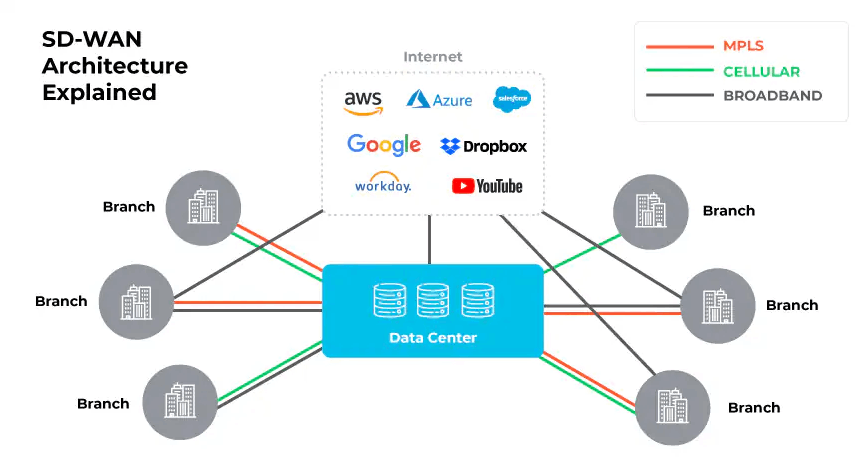
Advantages of SD WAN
Cost-effective: SD WANs can be more cost-effective than traditional WANs, as they can use cheaper Internet connections to connect geographically dispersed locations.
Agility: SD WANs offer greater agility and flexibility, as they can dynamically route traffic over multiple network paths, allowing organizations to respond quickly to changing network conditions.
Simplified management: SD WANs can be easier to manage than traditional WANs, as they offer centralized management and configuration.
Disadvantages of SD WAN
Security: SD WANs can be less secure than traditional WANs, as they rely on the public Internet to transport traffic.
Reliability: SD WANs can be less reliable than traditional WANs, as they rely on the public Internet, which can be subject to congestion, packet loss, and other performance issues.
Complexity: SD WANs can be complex to implement and configure, as they require specialized skills and expertise in software-defined networking.
THE COMPARISON
Reliability and Prioritization
Overall, traditional WANs running over MPLS offer great Quality of Service (QoS), since they avoid packet loss by virtually isolating packets. Most of the time, this is run over one carrier-grade circuit connection. One thing to keep in mind though is that MPLS bandwidth like this is typically more expensive.
Prioritizing what traffic gets higher priority is essential, helping organizations ensure their calls aren’t dropped. Traditional WAN technology allows for prioritization and can give you that traffic predictability and reliability.
Research reveals that internet costs can be reduced with SD-WAN. This is due to the fact that you don’t have to pay as much to upgrade your bandwidth, along with the ability to cost-effectively mix and match network links, according to the content type and priority. SD-WAN can run on 4G LTE and internet broadband, which is typically less expensive than service delivered via an MPLS network.
SD-WAN allows you to send your most important data traffic over the best network link, along with dozens of application prioritization options. This leads to little or no latency and packet loss. Additionally, if an outage occurs, your traffic is switched over to another connection instantly.
SECURITY
Traditional WAN is also considered secure. Over an MPLS connection, packets that are sent are private, and can only be seen by the destined MPLS connection, allowing site-to-site secure communication.
SD-WAN keeps your data traffic secure by providing end-to-end encryption over a virtual private network (VPN) connection. This technology also allows you to easily implement and integrate additional security layers, such as a firewall and related services for unified threat management.
CONTROL AND SCALABILITY
When changes to your traditional WAN are needed, it has to be done manually. This can take longer and decrease efficiency for growing businesses—especially those adding branch offices.
Ultimately, the decision between traditional WAN and SD-WAN depends on your organization’s situation and current infrastructure. Many organizations are making the switch to SD-WAN, but everyone’s circumstances are different. It comes down to what will be more beneficial for your short-term objectives and long-term needs.
HOW COULD SD-WAN BENEFIT YOUR BUSINESS?
Solutions-Hosting -Server Hosting
Energia has two offerings under our hosting facilities:
1. Server Farm VMWare:
2. Microsoft Azure
Definition – What does Server Farm mean?
A server farm is a set of many servers interconnected together and housed within the same physical facility. A server farm provides the combined computing power of many servers by simultaneously executing one or more applications or services. A server farm is generally a part of an enterprise data center or a component of supercomputer. A server farm is also known as a server cluster or computer ranch.
Definition – Microsoft Azure

Microsoft Azure is a cloud computing service created by Microsoft for building, testing, deploying, and managing applications and services through Microsoft-managed data centers. Microsoft Azure, formerly known as Windows Azure, is Microsoft’s public cloud computing platform. It provides a range of cloud services, including compute, analytics, storage and networking. Users can pick and choose from these services to develop and scale new applications, or run existing applications, in the public cloud.
Difference Between Traditional WAN and SD WAN
Traditional WAN
- Traditional WAN provides a conventional approach of managing Wide Area Network.
- It fails to provide a better flexibility in WAN management.
- New configuration and scale up takes very high time.
- In traditional network configuration is done by skilled resources means requires human intervention.
- It does not provide low cost and high speed connectivity.
- It provides low performance for the application in cloud as it connects to intermediate hub then to cloud.
- In traditional WAN, Data centers are limited in their capacity to deal with incoming connections to multiple cloud platforms.
- Traditional WAN increases the complexity associated with management, configuration and infrastructure arrangement of WANs.
- Traditional WAN solutions may not provides secure VPN like SD WAN and also fails to fully integrate additional features like firewall, Wan Optimization, SWG etc.
- Traditional WAN is secure over an MPLS connection as packets that are sent are private as well as packet loss is avoided.
SD WAN
- Software Defined WAN provides a software defined approach of managing Wide Area Network.
- It provides a better flexibility in WAN management.
- New configuration and scale up takes very low time.
- In SD WAN network configuration is done by automatically without requiring human intervention.
- It provides low cost and high speed connectivity.
- It provides high performance for the application in cloud as it directly access applications hosted in cloud.
- In Software Defined WAN, Data centers are not limited based on underlying hardware that comprises the network.
- Software Defined WAN simplifies the complexity associated with management, configuration and infrastructure arrangement of WANs.
- SD WAN solutions provides secure VPN than traditional WAN and also integrates additional features like firewall, Wan Optimization, SWG etc.
- SD WAN provides a secured data traffic through end-to-end encryption over a virtual private network (VPN) connection also integrates additional security features.
Conclusion
SD-WAN represents a significant shift in WAN architecture, offering greater flexibility, scalability, and cost-effectiveness than traditional WAN solutions. SD-WAN’s software-defined overlay network architecture, dynamic traffic routing, network visibility, and enhanced security features make it an attractive solution for organizations looking to optimize their WAN performance and reduce costs.
Difference Between Traditional WAN and SD WAN - FQAs
Can SD-WAN completely replace Traditional WAN?
In some cases, SD-WAN can be used instead of Traditional WAN but in other cases, an organization may intentionally implement both technologies.
Is SD-WAN more secure than Traditional WAN?
SD-WAN can be secure though Most of the deployments rely on public internet connections While Traditional WAN utilizes private circuits for connectivity.
How does SD-WAN improve cloud application performance?
Traffic to cloud interconnects is also prioritized in SD-WAN to enable it directly connect with the cloud without delay hence enhance the users experience.